What’s wrong with my picture book manuscript having 1500 words?
I’ve answered this question twice this month for prospective authors, so for others who may be wondering, let me explain:
Most of us in children’s publishing hear “1500 word picture book” and we immediately suspect a problem. That’s because publishers are saying that they want picture books under 800 words, while many prefer under 500.
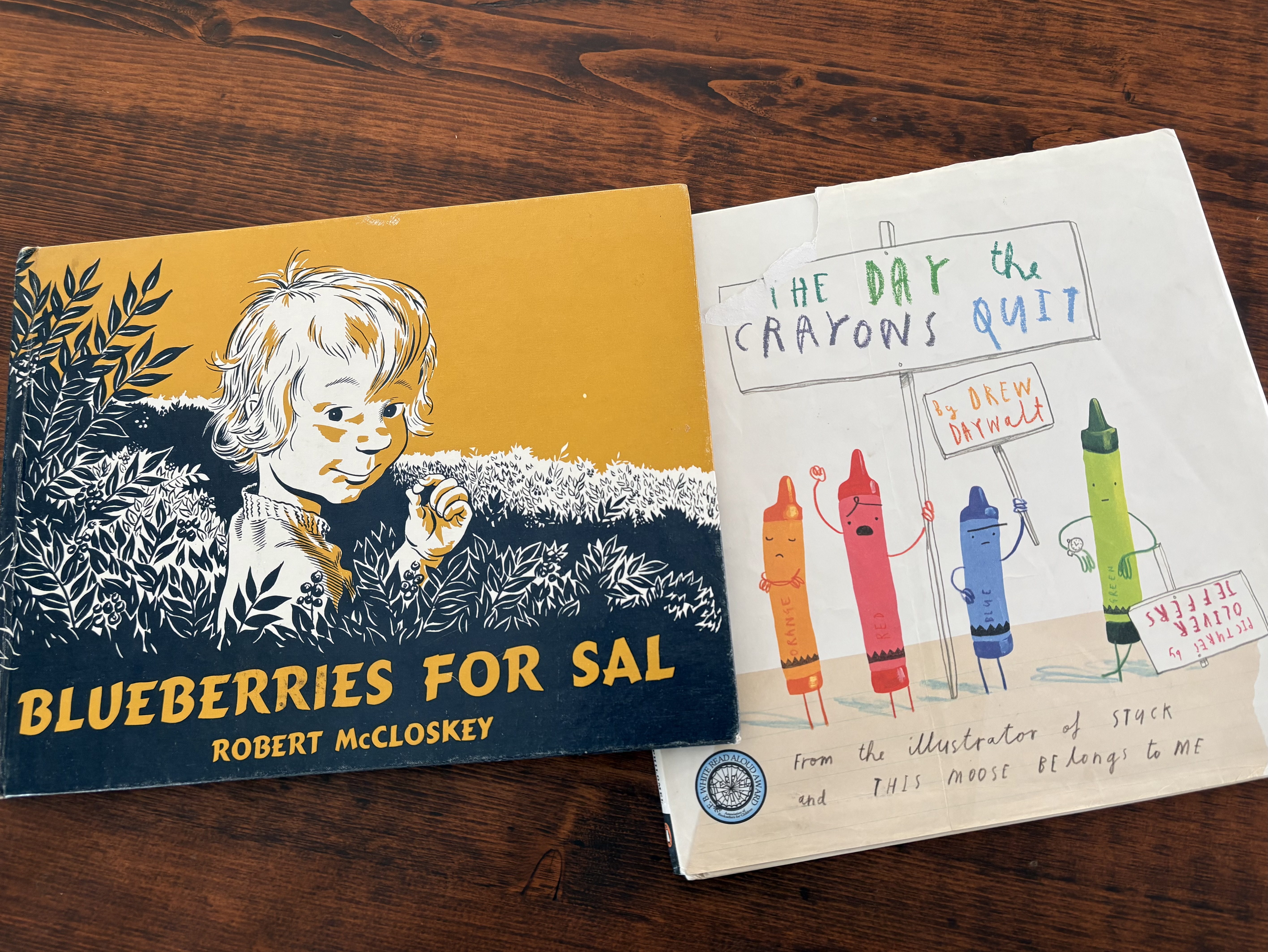
Picture books being published today are not like the picture books that we read as kids. As a fiction book, the classic, BLUEBERRIES FOR SAL, would have a hard time getting published today at 1,276 words.
Here are my theories on why this is:
- There are more choices now. More competition in books, and also in media in general.
- Kids have shorter (TikTok) attention spans. The average episode of Bluey is a snappy 7 minutes, compared to a half hour of slow-paced Mr. Rodgers when I was a kid.
- Parents are busy, and there are some books you they look at and think, “nope! No way I’m getting started reading that out loud.” (One of my kids was obsessed with animal nonfiction and sometimes they are both incredibly long AND incredibly dry and I… just… couldn’t.)
- Publishers can optimize their cost by making books just 32 or 40 pages (multiples of 8 are most cost effective because of how the pages are cut).
It’s not just picture books either. All categories of children’s publishing are dropping in word count. Chapter books are shorter, illustrated graphic novels with tiny word counts are everywhere, even books for teens are shrinking.
Are there exceptions? Definitely.
Drew Daywalt’s THE DAY THE CRAYONS QUIT (2013) is 999 words. That’s pretty long, but remember that Drew Daywalt was a well-known scriptwriter before his first book.
THE PRINCESS IN BLACK SERIES (2016) claims an in-between place as a 2500 word fully illustrated “transitional chapter book”. More expensive for the publisher to produce for sure, but who hasn’t read something by Shannon Hale? She’s a legend. The publishers knew it would be a hit even if it’s not in a finely defined category.
Most of the exceptions we see are for seasoned authors (that publishers know are less of a gamble), or for nonfiction picture books, like ICE CREAM EVERYWHERE: SWEET STORIES FROM AROUND THE WORLD (2024), which is 1300 words with an additional 275 words of backmatter.
It’s best to assume that your book is NOT the exception, because unless you have a great reason for publishers to believe your book will be a success, they’re going to want to default to the formulas that work for them most often.
So what to do with my 1500 word manuscript?
First, decide what it really wants to be.
I recommend reading two books:
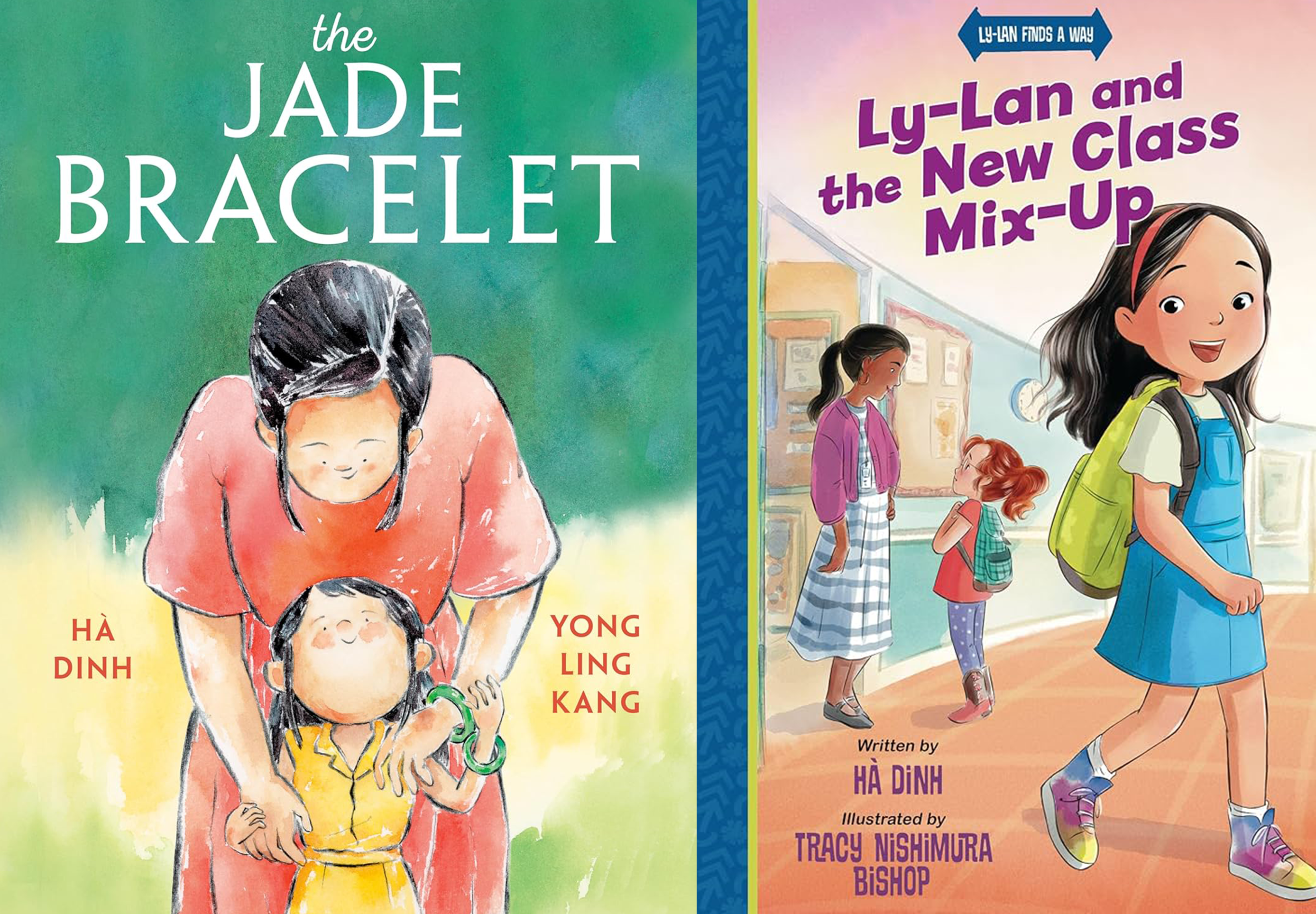
THE JADE BRACELET (2025)—an 862 word picture book by Hà Dinh about family, traditions, and how they sometimes conflict with friends at school. Its a little on the longer side, so I chose it as a great reference for people whose writing is not naturally a punchy or sparse style. Even over the 800 word mark, this book moves along nicely and the text works together with the illustrations to tell a full and rich story in just 40 pages. Its length also matches its audience of older, school aged picture book readers, about ages 5-8.
LY-LAN AND THE NEW CLASS MIX-UP (2025)—a 7,358 word chapter book by Hà Dinh about starting school, making friends, and what to do when things don’t go as planned. This size is perfect for an early chapter book for kids about ages 5-8. The Ly-Lan books have some simple spot illustrations, paired with more in-depth descriptions, and expanded plot lines and character development.
Both books came out last year for kids ages 5-8, about elementary school topics. Both books are loved by my third-grade daughter. Most importantly, these two books are written by the SAME author. Hà used her same amazing storytelling voice, but made adjustments to fit each story to the right genre.
I asked Hà what advice she would give authors whose word count is long for a picture book but short for a chapter book. She said,
“My advice to authors is to tell your story fully with concision and emotion. Your word count will vary significantly between the drafts and the final version. However, don’t let the word count hold you back from telling your story early in the process. Focus on developing a strong voice and plotline with memorable and compelling characters before you dive into revisions. Writing THE JADE BRACELET allowed me to be extremely selective with my word choice while allowing the illustrator to communicate the rest of the story through her gorgeous illustrations. On the other hand, writing the LY-LAN Series allowed me to paint a world full of details for my characters while helping the readers feel immersed in the chapters with the snippets of adorable illustrations throughout the book.”
I love her recommendation to write first and explore the world of your story to help you decide what format would benefit it the most. Does your character need more room to grow? Were you hoping to explore more aspects or challenges of your plot? Is your story best read to a child, or by a child on their own? Would the story benefit from vibrant color illustrations that work with the text? Do your words already paint a great mental picture?
Whether you decide you have a picture book or a chapter book on your hands, your next step will be to READ A TON of books in that genre written in the last 5 years so you really get to know the style.
How do I turn my long PB manuscript into a chapter book?
I’m not a chapter book author, so I’m going to refer you to an excellent post by Vicky Fang for Writer’s Rumpus. She breaks down how to know if your idea is a chapter book, and some of the important factors to consider. She also has a great video that shows the range of chapter books, from early and heavily illustrated to older and more spot illustrated, with great suggestions of books you can read to understand the genre.
How do I trim my picture book to the right length?
Okay, you’ve decided that the manuscript you have really does want to be a picture book. You took my advice and checked out a ton of recent picture books to study. Now, where can you start cutting back? Here are the most common places I see people get inflated in their word count:
Identify ONE problem:
Most picture books follow a simple arc: introduction, conflict, multiple attempts/failures, climax, and finally a resolution.
In a picture book you really only have time for one problem/goal. Your character will make multiple attempts at solving this problem, but for the story arc to be clear, you only have time in 32 pages to hit one challenge. What’s your character’s goal? Are all the things your character does leading towards that goal?
Once you’ve identified what the problem is, you can get rid of parts that don’t serve the story. Long introductions, funny moments that don’t serve the plot, and extra dialogue can all be trimmed out.
Crop your story window:
Recently I was critiquing a too-long story about a kid working through problems at school. The manuscript started when he woke up, got ready, and traveled to school–there was some great character development there, but he didn’t even arrive until page 9! My advice was to start the story with his school day, and work some of those important characterization pieces in alongside the developing plot.
Does your story start too soon? When does the action start? Could you cut the first pages?
Or maybe your story goes on too long after the ending. What happens if you cut the last page?
Let the Illustrations do the work:
Remember that one big difference between picture books and chapter books is how much description is needed. Check out this made-up excerpt:
“While her sister was downstairs, Casey stealthily put on her sister’s favorite yellow dress. She just couldn’t resist the bouncy frills and sleeves that fluttered like a butterfly. She gave a mischievous grin…”
There’s a lot of description here, and it sounds more like a line out of a chapter book because it paints a mental picture. The thing is, a picture book doesn’t need a mental picture… there already is a physical one.
In picture book circles, we use the phrase, “leave room for the illustrator.” In other words, the yellow dress will be shown, and the grin will be shown. Cut out most of the description and stick to the action and the emotional heart of the story, like,
“But when Carly went downstairs, Casey couldn’t help it. She just HAD to try on the dress…”
If the color of the dress matters in the plot, add an art note in your manuscript (illustration: the dress is yellow) so the potential publisher understands the story.
In my picture book, SAWYER’S BIG IDEA, I never say exactly what the project is that he’s building. The words “cardboard” and “robot” never appear, but kids pick it up because of the illustrations.
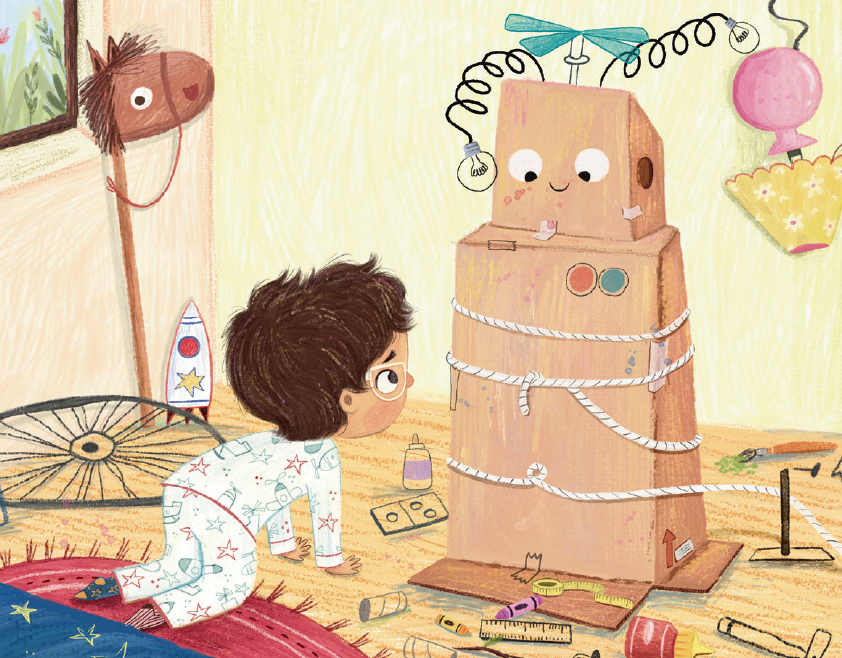
Just ask yourself, once this story is illustrated will my descriptions be redundant? Then cut the things that don’t need you to say them. Your character’s hair color, what they are wearing, and the time of day are great examples of things that probably don’t have to be said because the illustrator will take care of it for you. Save your words for the important stuff.
Consider Backmatter:
One choice to reduce word count is to keep the heart of the story, and provide a deeper dive in the back of the book. This works especially well with nonfiction books, but is also great for many fiction books that have historical ties, social/emotional lessons, or other true-to-life topics.
To quote nonfiction author Carolyn Bennett Frasier in her interview on Judy Campbell Smith’s Backmatter Breakdown for her book MOON TREE,
“My earliest version included much of the back matter in the text or in sidebars. The draft at that point was more than 1,500 words long! Too long for a picture book. As I revised, my text became shorter. Once I had the final version, I evaluated which extra details would help students and teachers take a deeper dive into the history and science behind the trees and re-envisioned the back matter to work hand-in-hand with the primary text.”
In the end, her story was 350 words, with an additional 1082 words of backmatter.
Check out Judy Campbell Smith’s Backmatter Breakdown blog series for more great ideas on using backmatter.
Omit Needless Words!
I first read this rule from Strunk & White in high school and it has been a beacon for me ever since:
“Vigorous writing is concise. A sentence should contain no unnecessary words, a paragraph no unnecessary sentences, for the same reason that a drawing should have no unnecessary lines and a machine no unnecessary parts. This requires not that the writer make all his sentences short, or that he avoid all detail and treat his subjects only in outline, but that he make every word tell.
— ”Elementary Principles of Composition”, The Elements of Style
Check out that guide for great ideas on trimming needless words, and examples like “he is a man who” becoming just “he”.
In picture books you only get a few hundred words, so it is crucial that all of them pull their weight. Get your words doing double duty—telling the story at the same time they show something about the character, evoke a feeling, or create a mood.
If you want some great examples of word thrift, Vivan Kirkfield’s #50preciouswords contest challenges authors to write a complete story in just 50 words. The contest entries are packed with words doing double and triple duty. Check out the entries, and maybe challenge yourself to participate next February-March.
Power up your language:
By choosing stronger verbs you can cut out the helper verbs and adjectives. In a quote from The Dead Poet Society, “A man’s not ‘very tired’ he’s “exhausted’. And don’t use ‘very sad’ use… ‘morose’.” It works for better description AND cuts wordcount. “Bob was really sad” has fewer words when it becomes “Bob was devastated.”
Think critically about whether the little words are pulling their weight, “Father looked sad” could become “father frowned”. The word “that” is one I personally love removing. “He thought that it was sad” vs “He thought it was sad”.
Also, consider your tense. Writing in the imperfect, “he was walking by” or the past progressive “he had been walking by” is much slower and wordier than in the perfect tense, “he walked by.”
Ask critique partners:
If you’re still having a hard time, ask critique partners to help your tighten up your text. They’ll probably be able to help you know what can be left out.
You can do it!
For more tips on writing picture books, check out my Writing Children’s Books 101 series:
Writing Children’s Books 101: An introduction to the series, and writing for children.
Routes to Getting Published: Part 1–Traditional vs. self-publishing. Do you need an agent? What about an illustrator? Making the right choices for your goals and your book.
Writing a Book for Children: Part 2–How to go about actually writing the book, revising it, and getting it polished.
Submitting a Children’s Book: Part 3–Making sure your manuscript is ready. Set up your document. Polish your story. Write query letters. Track your queries.
 Kimberly Horch