This is the third part in my series “Writing Children’s Books 101“ where I’m simplifying the process of getting a book published to answer the questions of many people who have asked me how they can publish the picture book they’ve always wanted to write.
This post is answering the questions “How do I submit a book?” and “How do I get an agent/publisher?”
You have been busy.
You have written a children’s book (post here) and you know you want it traditionally published (more on that here).
Now what do you do to submit it?
Polish Your Manuscript
Be sure your story is the best it can be! Run through my steps of writing a children’s book again, and spend a couple months in the critiquing->wordsmithing-> critiquing again cycle. Also, taking time to put it aside and come back will give you fresh eyes that will help you spot things you didn’t before. Author Bitsy Kemper has a great 13 point checklist that’s great to go through.
New authors often ask, “how do you know when it’s polished enough?” There’s not an exact answer, but some indicators might be:
- You take it to multiple critique partners and they are wowed and you don’t get much critical feedback.
- Over and over, suggested changes could make the story different (in a sideways direction), but not necessarily better because that’s all people can think of to suggest.
- Experienced authors or others in publishing tell you it’s ready.
- There are NO spelling or grammatical errors.
Submitting to an Agent? You May Want To Write More Stories
Many agents considering representing you for your career will ask to see more stories if they like your submission. It’s a good Idea to have at least 3 stories in submission-ready shape before you start pitching to agents. That way when they actually like your story and say, “I loved this and I’d like to see more” you’re not wasting the opportunity by not having something else ready.
Document Formatting
I have heard many agents and publishers say that they can tell just from looking at a document if an author knows their way around the industry, or if they just crawled out of a hole and decided to submit a story. That has to do with a number of standard formatting choices.
Like high school English class: 12-point, Times New Roman, double spaced, with 1 inch margins.
I include a header with my last name, book title, and page number. This came at the suggestion of an editor who said sometimes pages get separated if a manuscript gets passed around the office, and this helps keep everything together.

I also list key information at the top of the document. This is not exactly standardized, but many agents and editors want to know right upfront the age range and word count. The contact information helps (again) if your manuscript gets printed and they aren’t sure who it came from or how to reach you.
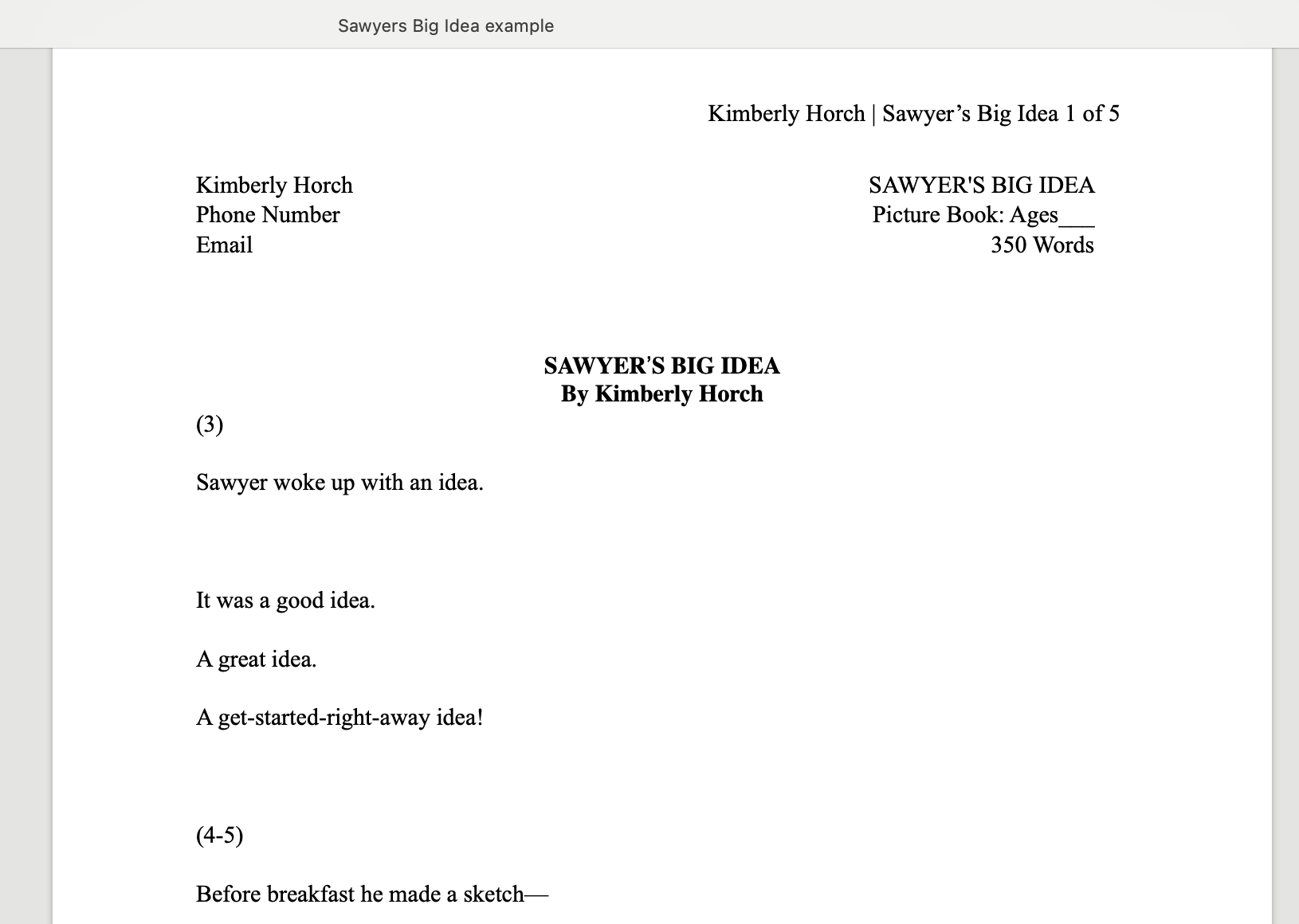
Breaking your picture book out into spreads is optional, but I find it helpful to clarify my vision, and keep editors from wondering if this is, in fact, the right length for a book. Just using parenthesis with the page number like I did above is fine. No need to get too wordy with it.
I like to break my text into short lines, but that has more to do with my writing style. Many picture book authors will have a short paragraph of text in one block.
For more info on formatting check out my friend Chelsea Tornetto’s video for At Home Author.
Have a Pitch
How would you explain your story to an editor? Your pitch is your 1-3 sentence explanation that captures the heart of your story without giving away the ending. This catches your editor’s interest and helps them know why they should read your story.
There are different ways to format this, but be sure to include: who or what the story is about, their goal, the obstacle, and the stakes.
Try to match the tone of the book, and be sure to show what makes the story unique.
The pitch that got me my contract for SAWYER’S BIG IDEA was:
Sawyer wakes up with an incredible, amazing, world-changing idea— but all day he gets hyperfocused, distracted, & discouraged. When bedtime arrives he hasn’t finished his idea, but realizes that he has accomplished much more than he set out to do.
Know Some Comp Titles
Comparative titles (we call them “comps”) are recently published works that tell an agent or editor what you envision and how your book fits in the market.
Usually you’ll have 2-3 comps. A comp should be recent (the last 5 years is pretty standard). It should be successful (showing that it did well so yours could too) but not too successful (if you comp Harry Potter the agent will probably think you’re delusional and have an unrealistic expectation for your book).
It’s helpful to have books that compare to your book in different ways. Like one that shares a similar theme, and one that has a similar main character, or style. This helps to show off the great things about your book, while explaining key differences. We will often explain the comps like: [my book] demonstrates that kindness is important like [comp], but with a fun and interactive format like [other comp].
Write a Query Letter
Some agents and editors will have a query form that asks for something else or has specific instructions, but most often you will submit your manuscript with a basic query letter.
This one page, usually 3-paragraph letter introduces your book, and then you. The format usually looks like this:
Paragraph 1—greeting. Introducing your book by giving the title, genre, wordcount, and audience age. Explain your comps in 1-2 sentences.
Paragraph 2—Pitch your book. I use my story pitch (see above), and follow it up with a sentence about why it is an important story and why I am the right author for it. In my query letter for SAWYER’S BIG IDEA, after my pitch I added:
True to my own experience, this story focuses on celebrating the creativity and processes of kids who get hyperfocused, distracted, and present other symptoms of ADHD, helping them to see their struggles in a positive light.
Paragraph 3—Your relevant bio. Nothing too personal. List any other writing experience, or experience that relates to the topic of your book. Let them know if you have a social media following, and how you are engaged in learning to be a better writer. This is another time that joining SCBWI, taking a writing course, entering a writing contest, or being in a regular critique group come in handy.
It takes practice and experience to write a query letter well. Watch some videos, or take a class on how to do it. Have your query critiqued just like you would a manuscript.
Start Submitting
Once you have all those parts written and polished you are ready to “go on submission”.
Find an agent or publisher that is open for submissions and follow their instructions. Many will use a form and have you either copy and paste the submission pieces, or upload documents for your query and manuscript.
This is a great post by Tiffany Hawk about finding agents to submit to, including using Publisher’s Marketplaces and looking up manuscript wish lists (MSWLs).
I liked to send out 6-12 submissions at a time since I had everything all lined up and ready. It was faster than waiting on one response for months at a time, but few enough that if I noticed a pattern in the responses that I could make changes.
Track your submissions on a spreadsheet. Keep track of who you submitted to, and which agency and what date. I also add a note if they gave an estimate of how long it will take. This is important because some agencies only allow a submission to one agent at a time, or request that you wait 6 months between submissions. Tracking allows you to follow their requests, and following directions keeps you off the blacklist.
Then you wait. This is hard, but resist the urge to check in unless they specifically asked you to “check in if you haven’t heard from me in 2 months” or something like that. Agents and publishers receive many submissions and they will work through their pile as they are able.
Get Rejected, Try Again
Rejections are part of the industry, and they are hard to take. The fact is that most stories are rejected dozens, if not hundreds of times before they find the right home. We all find ways to deal with the emotional impacts of this–personally, I made up a little rejection celebration dance to remind myself that a rejection means trying. You miss %100 of the shots you don’t take.
If a story keeps getting the same reaction from agents or editors (i.e. I like the idea, but the beginning didn’t grab me), consider if a change would fix the problem. Or maybe you’re sending it to the wrong people.
Often the rejections have nothing to do with the story at all, just a matter of not quite the right thing at the right time. Keep trying. You’ve got this!
Final Thoughts
My goal in writing all this was to give an overview, but each of these sections is scratching the surface of things you will learn on your journey. I have seen entire workshops dedicated to each of those topics. Hopefully now you know at least all the things to look into and you have the vocabulary to find help.
Any other questions? Let me know in the comments!
Good luck! I can’t wait to see your story in print!
Writing Children’s Books 101:
Writing Children’s Books 101: Introduction to the series, and writing for children.
Routes to Getting Published: Part 1–Traditional vs. self-publishing. Do you need an agent? What about an illustrator? Making the right choices for your goals and your book.
Writing a Book for Children: Part 2–How to go about actually writing the book, revising it, and getting it polished.
Submitting a Children’s Book: YOU ARE HERE! Part 3–Making sure your manuscript is ready. Set up your document. Polish your story. Write query letters. Track your queries.
 Kimberly Horch