This is the first part in my series “Writing Children’s Books 101“ where I’m simplifying the process of getting a book published to answer the questions of many people who have asked me how they can also become an author.
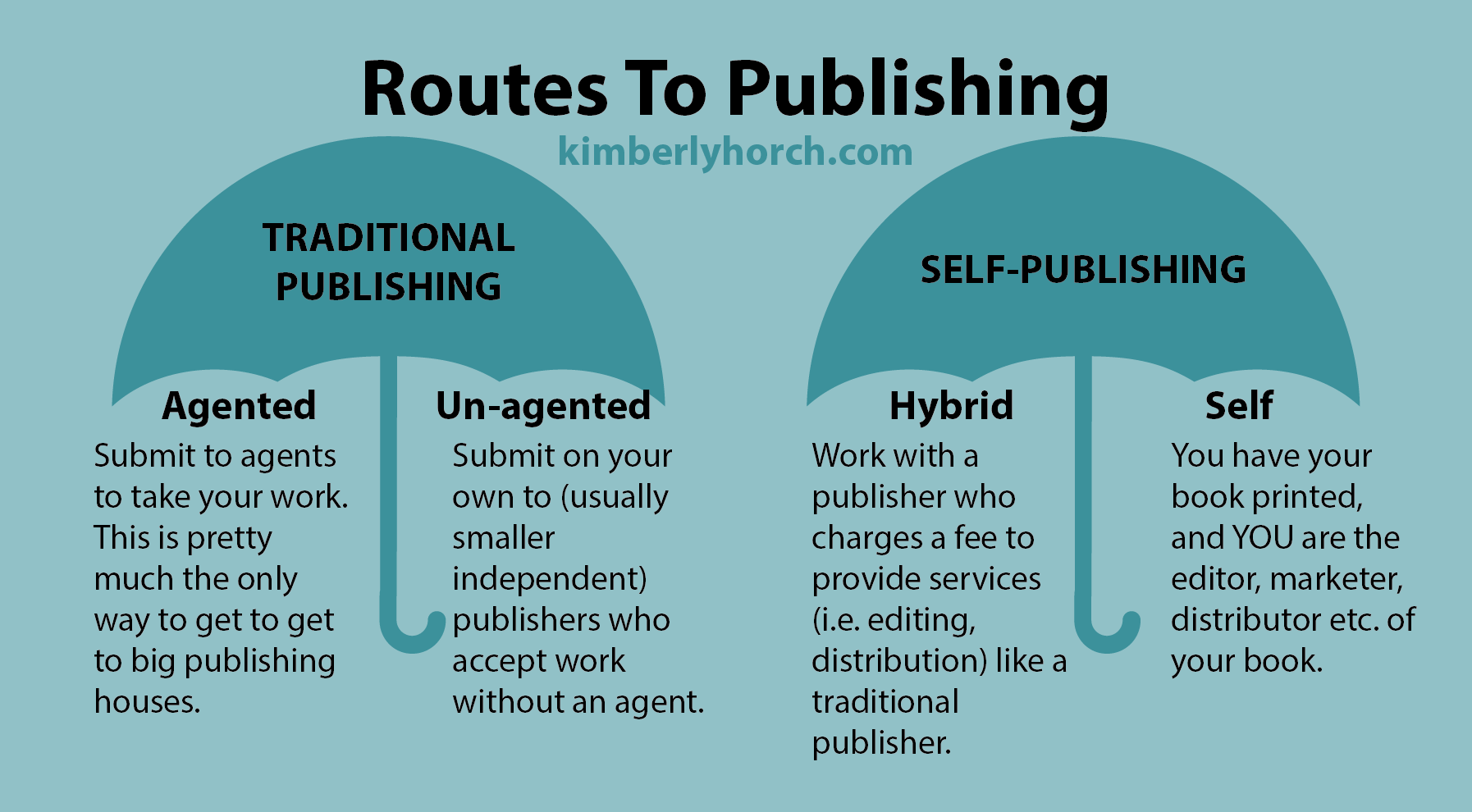
There are two main umbrellas of publishing for us authors to choose from: Traditional and self-publishing. And there are a couple ways to do each of those. I’m looking at this from a children’s picture book perspective, but all of these will apply to whatever genre you write.
Traditional Publishing:
Traditional publishing is what most people think of when they talk about publishing. A publisher takes the book that you have written and works with you to make any changes, then they print it and distribute it through their own established channels. These are the books that end up in bookstores and libraries (many libraries only purchase traditionally published work). These publishers are taking a chance on your book, that it will sell and make them money, so they will only choose to publish your book if they think it will do well. Marketability is a key consideration for them.
To answer one my most asked questions by prospective authors, YOU DO NOT NEED TO FIND AN ILLUSTRATOR if you go the traditional publishing route. In fact, traditional publishers would prefer you don’t. When your book is signed, the editor will find a good illustrator for you. That takes a load off doesn’t it? There are a lot of details like this you don’t have to worry about if you go the traditional publishing route.
Traditional presses range from really big (Penguin, HarperCollins, Scholastic) to very small presses that publish just a couple books a year.
Speed: This is a publishing route that can be very slow. It takes time to submit and find the right home for your book, and from the time you sign a contract it is likely to be around two years before the book comes out.
Bottom Line: Because a traditional publisher has established distribution channels and often a marketing team, a traditionally published book will likely sell more copies… but your royalties on the total sales will usually be between 5%-10% of the total book sales. Also, a real, traditional publisher will NEVER charge you money… if a publisher asks for a down payment thats a scam red flag!
You can be traditionally published with or without an agent:
—With An Agent—
An agent signs a contract with you to submit your work and represent you to publishing companies. An agent will never charge you for their work (beware of scams–a legit agent will never charge you) instead, they get a portion of the royalties from the deals that they make in your behalf.
Working with an agent isn’t just helpful, its necessary if you want your book to be published by one of the big publishing houses (where books that hit it big, become best-sellers and household names tend to come from). Big publishing houses rarely accept work that is un-agented (for many reasons including that work submitted by an agent has already been vetted, and it will be easier to work through a professional agent in making the deal).
Pros:
- Bigger publishing opportunities
- Having an agent frees up your time to write, because the agent takes on tasks of pitching and searching for places to submit.
- You have someone on your team, working to improve your work and find it a home. Many agents will give editorial feedback that will make your story even better.
Cons:
- You have to convince an agent to take on your work. That involves a submission process that includes a lot of searching, rejection, and finding a good match. This process can take years.
- An agent typically wants to represent you for a career rather than one book, so this is a better choice for people with several stories and who are interested in being an author in the long term.
- If you write a new story your agent doesn’t think publishers will want, they may choose not to submit it.
- A percentage (usually around 15%) of your royalties will go to your agent for their hard work.
—Without An Agent—
There are many smaller and independent presses that will publish the work of an author without an agent. Some of these are open for general submissions—there is an extensive list kept up by Author Bitsy Kemper of publishers that accept un-agented submissions:
In addition to those publishers, others might be open by invitation, such as if an editor liked your story at a pitch event, or if you met them at a writing conference. This is the case with my book, SAWYER’S BIG IDEA, I was not agented when I signed the contract, but had an opportunity to submit to the editor because of an SCBWI writing conference I participated in, even though Magination Press is not typically open to un-agented submissions.
Pros:
- You can look directly for what a publisher wants instead of having to catch the attention of an agent and then a publisher.
- This might be a better route if you have just 1 or 2 picture books you would like to see published (rather than planning a career as an author of multiple books).
- Smaller, niche publishers can move a little faster than big ones, I have seen books go from contract signed to published in less than 18 months, but this is not always the case (If you are agented, these smaller publishers are still an option).
- You keep all your royalties.
Cons:
- Limited submission opportunities.
- If you get an offer, it will be up to you to review the terms of a contract, negotiate and work out that legal stuff on your own. I’m going to be honest, when I had two offers for my picture book, it was a little stressful to negotiate and make the best choice for my book on my own.
- With my first picture book, I was a little clueless about how things would go. An agent would have known answers to questions that I had to ask the publisher. I was always a little nervous that I was asking them too many questions or being needy. An agent helps to mediate those things.
- Smaller presses often ask their authors to do more on the marketing side. Sometimes they require authors to submit a marketing plan along with their story to show how they plan to be involved and support the sale of the book.
Self-Publishing:
Self-publishing is when you as the author take matters into your own hands. You become the publisher, making decisions as you see fit for your book.
STOP! Before deciding to go this route ask yourself, is your book really the best it could be? Is it really ready to be published? In my opinion, some authors choose to self-publish as an alternative to putting enough time and effort into their book to make it quality. That’s why self-published books tend to have a stigma of being not as good—they haven’t gone through all the gatekeepers to determine that it really is ready, and sometimes errors and amateur decisions are quite obvious. But that’s not always the case! I have an author friend who self-publishes, and her books are QUALITY—fact checked, meticulously edited, and beautifully illustrated (check this one out!) She decided to self-publish to have more rights to do with her books what she wanted, as the director of a STEM non-profit. Before you hit “publish”, be sure to check out my next post on writing books for children, do your research, have people critique your work, maybe even hire an editor.
Speed: Hit publish when you are ready (but really, make sure you are ready).
Bottom Line: These options will cost you more upfront, either paying a hybrid press, or paying illustrators and editors out of your own pocket. However the royalties are much higher, and can be as much as 70% (but don’t forget that you will deduct from your earnings the costs of printing, an illustrator etc).
—Hybrid Publishing—
Hybrid and Vanity publishers both offer some services of traditional publishers, for people who would like to be the final decision maker with their own book. A hybrid press might offer editing, illustration, production and/or marketing services. These come AT THE COST OF THE AUTHOR to the tune of thousands of dollars. These presses don’t care if your book is well written or has an audience, instead they have the author pay for the publishing costs and shoulder the risk of whether or not the book sells. They offer a higher percentage of the royalties than traditional presses (although not as much as if you self-published) but there is NO GUARANTEE that you will recoup all of your costs to come out even, let alone to make money.
Scams abound in this segment–presses know you don’t have an agent who would carefully check a contract, and they may take advantage of the risk being your problem, not theirs.
If you want to go this route, look for reputable, established publishers, such as the “Jumpshot Program” offered by Bushel and Peck (who also has a small traditional publishing arm). You still may not recoup your cost, but you are less likely to find yourself scammed.
Pros:
- You can get published on a faster timeline. I have heard of authors who went this route because they didn’t care about making money, they just really wanted to get their book published before their grandkids were too old (or whatever).
- Can be a higher quality book than you would get going it completely alone… although I have heard of people scammed who end up with AI illustrations or shoddy printing.
Cons:
- Many of these companies are scams–offering services they will not deliver on, or with sneaky clauses in contracts that cause you to loose rights to your book! Be careful! Do your research!
- Only go this route if you understand and are okay with the idea that you will probably loose money, even with a reputable hybrid press. It is just difficult on your own to sell the volume necessary to pay for the cost of publishing a book the traditional way.
—Publishing Yourself—
To self-publish your own book, start by choosing a platform like Amazon’s Kindle Direct Publishing (KDP), Lulu, or IngramSpark. These companies are “print on demand” meaning they only print a book when someone orders it, meaning you won’t find yourself paying for lots of inventory and then not being able to sell it. The printer will do the actual physical printing of the book, and allow for distribution through their (limited) channels and that’s about it. You on the other hand become everyone else: editor, marketer, distributor, and every other hat. Don’t expect your book to take off on its own, this is a hands-on way to go!
If you join SCBWI, they have resources on self publishing, including a list of vetted self-publishing service providers such as editors and cover illustrators, and a self-publishing guide.
Pros:
- Can be a great choice for a book that has a specific niche (i.e. for kids with a specific rare disease) because while a publisher might not find that book generally marketable, you can tailor your marketing to that demographic.
- You make all the choices! You choose the text, the illustrations, how your book is positioned.
- You have all the rights to use your book where and how you choose.
- No rejections on submissions, and cut out the years of waiting for the cogs in the traditional industry to fall into place.
Cons:
- You have to make all the choices. Should you hire your niece who “does art” or a professional illustrator? (Hot tip: this is a choice that will make a HUMUNGUS difference for your book, don’t take it lightly or try to save a few bucks. I “do art” and do not intend to ever illustrate a book of my own, because I recognize that illustration really is its own art form with technique and considerations that us artists of other media have never learned to deal with).
- You pay for the things your book needs. There are upfront costs.
- You will spend less time writing and more time with the other parts of the publishing process.
- You will have to sell your book. For some people this alone is a deal-breaker because it feels uncomfortable for them to ask people to buy their book. If you’re not asking people to buy though, your self-published book Will. Not. Sell.
So that was my quick overview of your main choices in the publishing industry. Every author’s situation is different and they may make different choices to publish their book differently for different reasons.
The great news is that you are not locked into one path. I have a friend who is traditionally published with an agent, who decided to self publish a book because it didn’t find a traditional house. I sold my first book un-agented, and have since gotten an agent.
The important thing is to ask yourself, “Why am I pursuing this path with this book?” Consider what you hope to gain, and if you are okay with the shortcomings of your chosen method.
Now that you’ve got an idea of how publishing works, let’s get to Part 2: The actual writing of the children’s book.
Writing Children’s Books 101:
Writing Children’s Books 101: Introduction to the series, and writing for children.
Routes to Getting Published: Part 1–YOU ARE HERE! Traditional vs. self-publishing. Do you need an agent? What about an illustrator? Making the right choices for your goals and your book.
Writing a Book for Children: Part 2–How to go about actually writing the book, revising it, and getting it polished.
Submitting a Children’s Book: Part 3–Making sure your manuscript is ready. Set up your document. Polish your story. Write query letters. Track your queries.
 Kimberly Horch